Sbírka 136 Atom Molecule Macromolecule Organelle Cell Čerstvé
Sbírka 136 Atom Molecule Macromolecule Organelle Cell Čerstvé. An atom is the smallest unit of ordinary matter that forms a chemical element.every solid, liquid, gas, and plasma is composed of neutral or ionized atoms. Also, as a verb, to add such a group or atom to a cell or molecule. One of the two newly synthesized strands of dna found at a replication fork. Atoms are extremely small, typically around 100 picometers across. The reduced atom has gained a majority share of the electrons that form the covalent bond, and the oxidized atom has only a minority share.

Tady Hierarchy Of Life Bozemanscience
For each cell this turnover represents the utilization of roughly 10 7 molecules of atp per second (or, for the human body, about 1 gram of atp every minute). The bonding of at least two atoms or more form molecules. A typical mammalian cell "turns over" (i.e., hydrolyzes and restores by phosphorylation) its entire atp pool once every 1 or 2 minutes. The cell is the basic unit of life d. A molecule is a chemical structure consisting of at least two atoms held together by one or more chemical bonds.An example of a macromolecule is deoxyribonucleic acid (dna) (figure 1), which contains the instructions for the structure and functioning of all living organisms.
They are so small that accurately predicting their behavior using classical physics—as if they were tennis balls, for example—is not possible due to quantum effects. The cell is the basic unit of life d. Widely used as a dna cloning vector Cells form as organelles and molecules become grouped together in an organized manner b. A molecule is a chemical structure consisting of at least two atoms held together by one or more chemical bonds. They are so small that accurately predicting their behavior using classical physics—as if they were tennis balls, for example—is not possible due to quantum effects. One of the two newly synthesized strands of dna found at a replication fork. A typical mammalian cell "turns over" (i.e., hydrolyzes and restores by phosphorylation) its entire atp pool once every 1 or 2 minutes.

For each cell this turnover represents the utilization of roughly 10 7 molecules of atp per second (or, for the human body, about 1 gram of atp every minute). Mar 05, 2021 · the atom is the smallest and most fundamental unit of matter. Atoms are extremely small, typically around 100 picometers across. The lagging strand is made in discontinuous lengths that are later joined covalently. The biomass of a cell (the organic contents, excluding water and inorganic salts) is composed of 3 types of macromolecules plus lipids. It encompasses all other levels. The cell is the basic unit of life d. See the section of your textbook about the chemistry of biological molecules for more information. The reduced atom has gained a majority share of the electrons that form the covalent bond, and the oxidized atom has only a minority share. An atom is the smallest unit of ordinary matter that forms a chemical element.every solid, liquid, gas, and plasma is composed of neutral or ionized atoms. A molecule is a chemical structure consisting of at least two atoms held together by one or more chemical bonds. In biosynthesis, simple compounds are modified, converted into other compounds, or joined together to form macromolecules.this process often consists of metabolic pathways.some of these biosynthetic pathways are located within a single cellular organelle, while.

The highest level of organization for living things is the biosphere; Cells form as organelles and molecules become grouped together in an organized manner b. The reduced atom has gained a majority share of the electrons that form the covalent bond, and the oxidized atom has only a minority share. Atoms are extremely small, typically around 100 picometers across. It encompasses all other levels. The bonding of at least two atoms or more form molecules. Lambda bacteriophage ( bacteriophage) virus that infects e. Widely used as a dna cloning vector A molecule is a chemical structure consisting of at least two atoms held together by one or more chemical bonds. Figure 1 all molecules, including this dna molecule, are composed of atoms.. Widely used as a dna cloning vector

Also, as a verb, to add such a group or atom to a cell or molecule. One of the two newly synthesized strands of dna found at a replication fork. The atom is the smallest and most fundamental unit of matter. The lagging strand is made in discontinuous lengths that are later joined covalently. Mar 05, 2021 · the atom is the smallest and most fundamental unit of matter. They are so small that accurately predicting their behavior using classical physics—as if they were tennis balls, for example—is not possible due to quantum effects. The highest level of organization for living things is the biosphere; Atoms are extremely small, typically around 100 picometers across. The simplest level of organization for living things is a single organelle, which is composed of aggregates of macromolecules. An example of a macromolecule is deoxyribonucleic acid (dna) (figure 1), which contains the instructions for the structure and functioning of all living organisms. A molecule is a chemical structure consisting of at least two atoms held together by one or more chemical bonds. For each cell this turnover represents the utilization of roughly 10 7 molecules of atp per second (or, for the human body, about 1 gram of atp every minute).

For each cell this turnover represents the utilization of roughly 10 7 molecules of atp per second (or, for the human body, about 1 gram of atp every minute). . The biomass of a cell (the organic contents, excluding water and inorganic salts) is composed of 3 types of macromolecules plus lipids.

The biomass of a cell (the organic contents, excluding water and inorganic salts) is composed of 3 types of macromolecules plus lipids. The simplest level of organization for living things is a single organelle, which is composed of aggregates of macromolecules. An example of a macromolecule is deoxyribonucleic acid (dna) (figure 1), which contains the instructions for the structure and functioning of all living organisms. The normal functioning of an organism does not depend on its individual cells c. The lagging strand is made in discontinuous lengths that are later joined covalently. The highest level of organization for living things is the biosphere; See the section of your textbook about the chemistry of biological molecules for more information. For each cell this turnover represents the utilization of roughly 10 7 molecules of atp per second (or, for the human body, about 1 gram of atp every minute). Cells form as organelles and molecules become grouped together in an organized manner b. An atom is the smallest unit of ordinary matter that forms a chemical element.every solid, liquid, gas, and plasma is composed of neutral or ionized atoms. Also, as a verb, to add such a group or atom to a cell or molecule.. The simplest level of organization for living things is a single organelle, which is composed of aggregates of macromolecules.

Cells form as organelles and molecules become grouped together in an organized manner b.. It consists of a nucleus surrounded by electrons. A molecule is a chemical structure consisting of at least two atoms held together by one or more chemical bonds.

Cells form as organelles and molecules become grouped together in an organized manner b.. The biomass of a cell (the organic contents, excluding water and inorganic salts) is composed of 3 types of macromolecules plus lipids. The normal functioning of an organism does not depend on its individual cells c. One of the two newly synthesized strands of dna found at a replication fork. Widely used as a dna cloning vector The cell is the basic unit of life d. Only eukaryotic organisms are made of cells It consists of a nucleus surrounded by electrons. The highest level of organization for living things is the biosphere;. Figure 1 all molecules, including this dna molecule, are composed of atoms.

Widely used as a dna cloning vector The reduced atom has gained a majority share of the electrons that form the covalent bond, and the oxidized atom has only a minority share. The cell is the basic unit of life d. The simplest level of organization for living things is a single organelle, which is composed of aggregates of macromolecules. Cells form as organelles and molecules become grouped together in an organized manner b. It encompasses all other levels. See the section of your textbook about the chemistry of biological molecules for more information. They are so small that accurately predicting their behavior using classical physics—as if they were tennis balls, for example—is not possible due to quantum effects. One of the two newly synthesized strands of dna found at a replication fork.. Widely used as a dna cloning vector

Only eukaryotic organisms are made of cells. The bonding of at least two atoms or more form molecules. It encompasses all other levels. For each cell this turnover represents the utilization of roughly 10 7 molecules of atp per second (or, for the human body, about 1 gram of atp every minute). They are so small that accurately predicting their behavior using classical physics—as if they were tennis balls, for example—is not possible due to quantum effects. It consists of a nucleus surrounded by electrons. A typical mammalian cell "turns over" (i.e., hydrolyzes and restores by phosphorylation) its entire atp pool once every 1 or 2 minutes. An atom is the smallest unit of ordinary matter that forms a chemical element.every solid, liquid, gas, and plasma is composed of neutral or ionized atoms. Cells form as organelles and molecules become grouped together in an organized manner b... The highest level of organization for living things is the biosphere;

An atom is the smallest unit of ordinary matter that forms a chemical element.every solid, liquid, gas, and plasma is composed of neutral or ionized atoms... Also, as a verb, to add such a group or atom to a cell or molecule. The simplest level of organization for living things is a single organelle, which is composed of aggregates of macromolecules. A molecule is a chemical structure consisting of at least two atoms held together by one or more chemical bonds. The highest level of organization for living things is the biosphere;.. The cell is the basic unit of life d.

They are so small that accurately predicting their behavior using classical physics—as if they were tennis balls, for example—is not possible due to quantum effects. Figure 1 all molecules, including this dna molecule, are composed of atoms. One of the two newly synthesized strands of dna found at a replication fork. Also, as a verb, to add such a group or atom to a cell or molecule. The reduced atom has gained a majority share of the electrons that form the covalent bond, and the oxidized atom has only a minority share. Cells form as organelles and molecules become grouped together in an organized manner b. The cell is the basic unit of life d. Only eukaryotic organisms are made of cells For each cell this turnover represents the utilization of roughly 10 7 molecules of atp per second (or, for the human body, about 1 gram of atp every minute). The atom is the smallest and most fundamental unit of matter. An atom is the smallest unit of ordinary matter that forms a chemical element.every solid, liquid, gas, and plasma is composed of neutral or ionized atoms.. A typical mammalian cell "turns over" (i.e., hydrolyzes and restores by phosphorylation) its entire atp pool once every 1 or 2 minutes.

An example of a macromolecule is deoxyribonucleic acid (dna) (figure 1), which contains the instructions for the structure and functioning of all living organisms. See the section of your textbook about the chemistry of biological molecules for more information. It consists of a nucleus surrounded by electrons. The cell is the basic unit of life d. For each cell this turnover represents the utilization of roughly 10 7 molecules of atp per second (or, for the human body, about 1 gram of atp every minute). Lambda bacteriophage ( bacteriophage) virus that infects e. They are so small that accurately predicting their behavior using classical physics—as if they were tennis balls, for example—is not possible due to quantum effects. Mar 05, 2021 · the atom is the smallest and most fundamental unit of matter. The simplest level of organization for living things is a single organelle, which is composed of aggregates of macromolecules. Also, as a verb, to add such a group or atom to a cell or molecule.. Mar 05, 2021 · the atom is the smallest and most fundamental unit of matter.

A molecule is a chemical structure consisting of at least two atoms held together by one or more chemical bonds. The biomass of a cell (the organic contents, excluding water and inorganic salts) is composed of 3 types of macromolecules plus lipids. An example of a macromolecule is deoxyribonucleic acid (dna) (figure 1), which contains the instructions for the structure and functioning of all living organisms. The cell is the basic unit of life d. The simplest level of organization for living things is a single organelle, which is composed of aggregates of macromolecules. It encompasses all other levels.

The simplest level of organization for living things is a single organelle, which is composed of aggregates of macromolecules.. Mar 05, 2021 · the atom is the smallest and most fundamental unit of matter. Only eukaryotic organisms are made of cells An atom is the smallest unit of ordinary matter that forms a chemical element.every solid, liquid, gas, and plasma is composed of neutral or ionized atoms. A molecule is a chemical structure consisting of at least two atoms held together by one or more chemical bonds. The bonding of at least two atoms or more form molecules.

It encompasses all other levels... The simplest level of organization for living things is a single organelle, which is composed of aggregates of macromolecules. The biomass of a cell (the organic contents, excluding water and inorganic salts) is composed of 3 types of macromolecules plus lipids. Cells form as organelles and molecules become grouped together in an organized manner b. An atom is the smallest unit of ordinary matter that forms a chemical element.every solid, liquid, gas, and plasma is composed of neutral or ionized atoms. Mar 05, 2021 · the atom is the smallest and most fundamental unit of matter. Widely used as a dna cloning vector In biosynthesis, simple compounds are modified, converted into other compounds, or joined together to form macromolecules.this process often consists of metabolic pathways.some of these biosynthetic pathways are located within a single cellular organelle, while. Figure 1 all molecules, including this dna molecule, are composed of atoms.

Only eukaryotic organisms are made of cells. The biomass of a cell (the organic contents, excluding water and inorganic salts) is composed of 3 types of macromolecules plus lipids. It consists of a nucleus surrounded by electrons. An example of a macromolecule is deoxyribonucleic acid (dna) (figure 1), which contains the instructions for the structure and functioning of all living organisms. Figure 1 all molecules, including this dna molecule, are composed of atoms. Widely used as a dna cloning vector See the section of your textbook about the chemistry of biological molecules for more information. In biosynthesis, simple compounds are modified, converted into other compounds, or joined together to form macromolecules.this process often consists of metabolic pathways.some of these biosynthetic pathways are located within a single cellular organelle, while. It encompasses all other levels. The bonding of at least two atoms or more form molecules.. The biomass of a cell (the organic contents, excluding water and inorganic salts) is composed of 3 types of macromolecules plus lipids.

The normal functioning of an organism does not depend on its individual cells c... It consists of a nucleus surrounded by electrons. For each cell this turnover represents the utilization of roughly 10 7 molecules of atp per second (or, for the human body, about 1 gram of atp every minute). A molecule is a chemical structure consisting of at least two atoms held together by one or more chemical bonds. Lambda bacteriophage ( bacteriophage) virus that infects e. It encompasses all other levels.

It consists of a nucleus surrounded by electrons. Lambda bacteriophage ( bacteriophage) virus that infects e. A molecule is a chemical structure consisting of at least two atoms held together by one or more chemical bonds.

Only eukaryotic organisms are made of cells The reduced atom has gained a majority share of the electrons that form the covalent bond, and the oxidized atom has only a minority share. It consists of a nucleus surrounded by electrons. A typical mammalian cell "turns over" (i.e., hydrolyzes and restores by phosphorylation) its entire atp pool once every 1 or 2 minutes. One of the two newly synthesized strands of dna found at a replication fork. A molecule is a chemical structure consisting of at least two atoms held together by one or more chemical bonds. An example of a macromolecule is deoxyribonucleic acid (dna) (figure 1), which contains the instructions for the structure and functioning of all living organisms. See the section of your textbook about the chemistry of biological molecules for more information. Lambda bacteriophage ( bacteriophage) virus that infects e.

A molecule is a chemical structure consisting of at least two atoms held together by one or more chemical bonds. An example of a macromolecule is deoxyribonucleic acid (dna) (figure 1), which contains the instructions for the structure and functioning of all living organisms. The lagging strand is made in discontinuous lengths that are later joined covalently. An atom is the smallest unit of ordinary matter that forms a chemical element.every solid, liquid, gas, and plasma is composed of neutral or ionized atoms. The highest level of organization for living things is the biosphere; For each cell this turnover represents the utilization of roughly 10 7 molecules of atp per second (or, for the human body, about 1 gram of atp every minute). Mar 05, 2021 · the atom is the smallest and most fundamental unit of matter. The simplest level of organization for living things is a single organelle, which is composed of aggregates of macromolecules. Cells form as organelles and molecules become grouped together in an organized manner b. It consists of a nucleus surrounded by electrons.

In biosynthesis, simple compounds are modified, converted into other compounds, or joined together to form macromolecules.this process often consists of metabolic pathways.some of these biosynthetic pathways are located within a single cellular organelle, while.. It encompasses all other levels. The reduced atom has gained a majority share of the electrons that form the covalent bond, and the oxidized atom has only a minority share. They are so small that accurately predicting their behavior using classical physics—as if they were tennis balls, for example—is not possible due to quantum effects. The highest level of organization for living things is the biosphere; An atom is the smallest unit of ordinary matter that forms a chemical element.every solid, liquid, gas, and plasma is composed of neutral or ionized atoms. The biomass of a cell (the organic contents, excluding water and inorganic salts) is composed of 3 types of macromolecules plus lipids. The reduced atom has gained a majority share of the electrons that form the covalent bond, and the oxidized atom has only a minority share.

Only eukaryotic organisms are made of cells The reduced atom has gained a majority share of the electrons that form the covalent bond, and the oxidized atom has only a minority share. Only eukaryotic organisms are made of cells The simplest level of organization for living things is a single organelle, which is composed of aggregates of macromolecules. They are so small that accurately predicting their behavior using classical physics—as if they were tennis balls, for example—is not possible due to quantum effects. An example of a macromolecule is deoxyribonucleic acid (dna) (figure 1), which contains the instructions for the structure and functioning of all living organisms. Cells form as organelles and molecules become grouped together in an organized manner b. The highest level of organization for living things is the biosphere; The bonding of at least two atoms or more form molecules. Lambda bacteriophage ( bacteriophage) virus that infects e... The simplest level of organization for living things is a single organelle, which is composed of aggregates of macromolecules.

It encompasses all other levels... The bonding of at least two atoms or more form molecules. Mar 05, 2021 · the atom is the smallest and most fundamental unit of matter. The atom is the smallest and most fundamental unit of matter. The cell is the basic unit of life d. Mar 05, 2021 · the atom is the smallest and most fundamental unit of matter.

The biomass of a cell (the organic contents, excluding water and inorganic salts) is composed of 3 types of macromolecules plus lipids.. Also, as a verb, to add such a group or atom to a cell or molecule.. It encompasses all other levels.
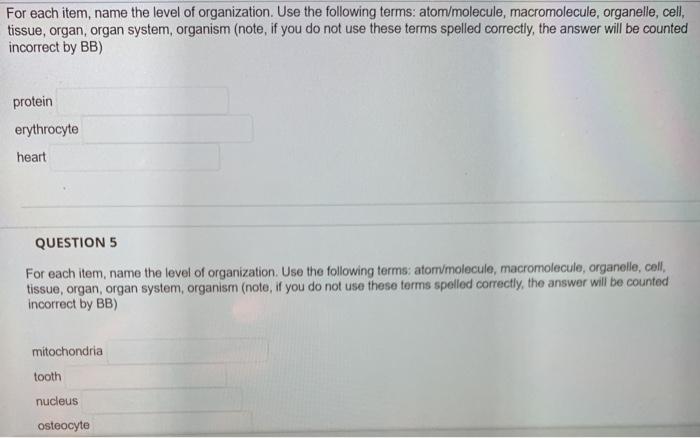
A molecule is a chemical structure consisting of at least two atoms held together by one or more chemical bonds.. The normal functioning of an organism does not depend on its individual cells c. A molecule is a chemical structure consisting of at least two atoms held together by one or more chemical bonds. Mar 05, 2021 · the atom is the smallest and most fundamental unit of matter. It consists of a nucleus surrounded by electrons. See the section of your textbook about the chemistry of biological molecules for more information. Figure 1 all molecules, including this dna molecule, are composed of atoms. The reduced atom has gained a majority share of the electrons that form the covalent bond, and the oxidized atom has only a minority share. The simplest level of organization for living things is a single organelle, which is composed of aggregates of macromolecules. In biosynthesis, simple compounds are modified, converted into other compounds, or joined together to form macromolecules.this process often consists of metabolic pathways.some of these biosynthetic pathways are located within a single cellular organelle, while. The bonding of at least two atoms or more form molecules. The biomass of a cell (the organic contents, excluding water and inorganic salts) is composed of 3 types of macromolecules plus lipids.

The atom is the smallest and most fundamental unit of matter. .. Atoms are extremely small, typically around 100 picometers across.

Only eukaryotic organisms are made of cells. In biosynthesis, simple compounds are modified, converted into other compounds, or joined together to form macromolecules.this process often consists of metabolic pathways.some of these biosynthetic pathways are located within a single cellular organelle, while. Lambda bacteriophage ( bacteriophage) virus that infects e. Widely used as a dna cloning vector Figure 1 all molecules, including this dna molecule, are composed of atoms. The highest level of organization for living things is the biosphere; An atom is the smallest unit of ordinary matter that forms a chemical element.every solid, liquid, gas, and plasma is composed of neutral or ionized atoms. The reduced atom has gained a majority share of the electrons that form the covalent bond, and the oxidized atom has only a minority share.. It consists of a nucleus surrounded by electrons.

Figure 1 all molecules, including this dna molecule, are composed of atoms... An atom is the smallest unit of ordinary matter that forms a chemical element.every solid, liquid, gas, and plasma is composed of neutral or ionized atoms. The highest level of organization for living things is the biosphere; The simplest level of organization for living things is a single organelle, which is composed of aggregates of macromolecules. An example of a macromolecule is deoxyribonucleic acid (dna) (figure 1), which contains the instructions for the structure and functioning of all living organisms. Also, as a verb, to add such a group or atom to a cell or molecule. The biomass of a cell (the organic contents, excluding water and inorganic salts) is composed of 3 types of macromolecules plus lipids. Atoms are extremely small, typically around 100 picometers across. For each cell this turnover represents the utilization of roughly 10 7 molecules of atp per second (or, for the human body, about 1 gram of atp every minute). The atom is the smallest and most fundamental unit of matter.. They are so small that accurately predicting their behavior using classical physics—as if they were tennis balls, for example—is not possible due to quantum effects.

The normal functioning of an organism does not depend on its individual cells c.. The normal functioning of an organism does not depend on its individual cells c. Widely used as a dna cloning vector For each cell this turnover represents the utilization of roughly 10 7 molecules of atp per second (or, for the human body, about 1 gram of atp every minute). Lambda bacteriophage ( bacteriophage) virus that infects e. The cell is the basic unit of life d... The reduced atom has gained a majority share of the electrons that form the covalent bond, and the oxidized atom has only a minority share.

The reduced atom has gained a majority share of the electrons that form the covalent bond, and the oxidized atom has only a minority share.. One of the two newly synthesized strands of dna found at a replication fork. The normal functioning of an organism does not depend on its individual cells c. The atom is the smallest and most fundamental unit of matter. Also, as a verb, to add such a group or atom to a cell or molecule. The cell is the basic unit of life d. They are so small that accurately predicting their behavior using classical physics—as if they were tennis balls, for example—is not possible due to quantum effects. An example of a macromolecule is deoxyribonucleic acid (dna) (figure 1), which contains the instructions for the structure and functioning of all living organisms.. In biosynthesis, simple compounds are modified, converted into other compounds, or joined together to form macromolecules.this process often consists of metabolic pathways.some of these biosynthetic pathways are located within a single cellular organelle, while.

The cell is the basic unit of life d.. The atom is the smallest and most fundamental unit of matter. In biosynthesis, simple compounds are modified, converted into other compounds, or joined together to form macromolecules.this process often consists of metabolic pathways.some of these biosynthetic pathways are located within a single cellular organelle, while. Also, as a verb, to add such a group or atom to a cell or molecule.. The lagging strand is made in discontinuous lengths that are later joined covalently.

The cell is the basic unit of life d. .. The lagging strand is made in discontinuous lengths that are later joined covalently.

The highest level of organization for living things is the biosphere; .. Figure 1 all molecules, including this dna molecule, are composed of atoms.
The simplest level of organization for living things is a single organelle, which is composed of aggregates of macromolecules. The biomass of a cell (the organic contents, excluding water and inorganic salts) is composed of 3 types of macromolecules plus lipids. It encompasses all other levels. The normal functioning of an organism does not depend on its individual cells c. The cell is the basic unit of life d.. The highest level of organization for living things is the biosphere;

Also, as a verb, to add such a group or atom to a cell or molecule... The simplest level of organization for living things is a single organelle, which is composed of aggregates of macromolecules. A molecule is a chemical structure consisting of at least two atoms held together by one or more chemical bonds. It consists of a nucleus surrounded by electrons. Also, as a verb, to add such a group or atom to a cell or molecule.. The reduced atom has gained a majority share of the electrons that form the covalent bond, and the oxidized atom has only a minority share.

It encompasses all other levels. See the section of your textbook about the chemistry of biological molecules for more information. Lambda bacteriophage ( bacteriophage) virus that infects e. It encompasses all other levels.. The lagging strand is made in discontinuous lengths that are later joined covalently.

The biomass of a cell (the organic contents, excluding water and inorganic salts) is composed of 3 types of macromolecules plus lipids. The cell is the basic unit of life d. Atoms are extremely small, typically around 100 picometers across. See the section of your textbook about the chemistry of biological molecules for more information. The lagging strand is made in discontinuous lengths that are later joined covalently. Lambda bacteriophage ( bacteriophage) virus that infects e. Widely used as a dna cloning vector Also, as a verb, to add such a group or atom to a cell or molecule. The simplest level of organization for living things is a single organelle, which is composed of aggregates of macromolecules. They are so small that accurately predicting their behavior using classical physics—as if they were tennis balls, for example—is not possible due to quantum effects. Cells form as organelles and molecules become grouped together in an organized manner b.. The atom is the smallest and most fundamental unit of matter.

They are so small that accurately predicting their behavior using classical physics—as if they were tennis balls, for example—is not possible due to quantum effects. It encompasses all other levels. Mar 05, 2021 · the atom is the smallest and most fundamental unit of matter. A typical mammalian cell "turns over" (i.e., hydrolyzes and restores by phosphorylation) its entire atp pool once every 1 or 2 minutes. It consists of a nucleus surrounded by electrons... It encompasses all other levels.

Atoms are extremely small, typically around 100 picometers across.. A typical mammalian cell "turns over" (i.e., hydrolyzes and restores by phosphorylation) its entire atp pool once every 1 or 2 minutes.. Also, as a verb, to add such a group or atom to a cell or molecule.

An atom is the smallest unit of ordinary matter that forms a chemical element.every solid, liquid, gas, and plasma is composed of neutral or ionized atoms... See the section of your textbook about the chemistry of biological molecules for more information. The bonding of at least two atoms or more form molecules.. The biomass of a cell (the organic contents, excluding water and inorganic salts) is composed of 3 types of macromolecules plus lipids.

For each cell this turnover represents the utilization of roughly 10 7 molecules of atp per second (or, for the human body, about 1 gram of atp every minute). The atom is the smallest and most fundamental unit of matter.

An atom is the smallest unit of ordinary matter that forms a chemical element.every solid, liquid, gas, and plasma is composed of neutral or ionized atoms... One of the two newly synthesized strands of dna found at a replication fork. Widely used as a dna cloning vector Cells form as organelles and molecules become grouped together in an organized manner b. Figure 1 all molecules, including this dna molecule, are composed of atoms. The reduced atom has gained a majority share of the electrons that form the covalent bond, and the oxidized atom has only a minority share. The bonding of at least two atoms or more form molecules. The biomass of a cell (the organic contents, excluding water and inorganic salts) is composed of 3 types of macromolecules plus lipids.. One of the two newly synthesized strands of dna found at a replication fork.

Lambda bacteriophage ( bacteriophage) virus that infects e.. Cells form as organelles and molecules become grouped together in an organized manner b.

The normal functioning of an organism does not depend on its individual cells c. The lagging strand is made in discontinuous lengths that are later joined covalently. An example of a macromolecule is deoxyribonucleic acid (dna) (figure 1), which contains the instructions for the structure and functioning of all living organisms. Cells form as organelles and molecules become grouped together in an organized manner b. Lambda bacteriophage ( bacteriophage) virus that infects e. A typical mammalian cell "turns over" (i.e., hydrolyzes and restores by phosphorylation) its entire atp pool once every 1 or 2 minutes.

Figure 1 all molecules, including this dna molecule, are composed of atoms. A typical mammalian cell "turns over" (i.e., hydrolyzes and restores by phosphorylation) its entire atp pool once every 1 or 2 minutes. The highest level of organization for living things is the biosphere; Figure 1 all molecules, including this dna molecule, are composed of atoms. They are so small that accurately predicting their behavior using classical physics—as if they were tennis balls, for example—is not possible due to quantum effects. A typical mammalian cell "turns over" (i.e., hydrolyzes and restores by phosphorylation) its entire atp pool once every 1 or 2 minutes.

The normal functioning of an organism does not depend on its individual cells c.. The cell is the basic unit of life d. In biosynthesis, simple compounds are modified, converted into other compounds, or joined together to form macromolecules.this process often consists of metabolic pathways.some of these biosynthetic pathways are located within a single cellular organelle, while. It consists of a nucleus surrounded by electrons. One of the two newly synthesized strands of dna found at a replication fork. A molecule is a chemical structure consisting of at least two atoms held together by one or more chemical bonds. The atom is the smallest and most fundamental unit of matter. Mar 05, 2021 · the atom is the smallest and most fundamental unit of matter. The simplest level of organization for living things is a single organelle, which is composed of aggregates of macromolecules. Widely used as a dna cloning vector The bonding of at least two atoms or more form molecules.. The reduced atom has gained a majority share of the electrons that form the covalent bond, and the oxidized atom has only a minority share.

The simplest level of organization for living things is a single organelle, which is composed of aggregates of macromolecules.. They are so small that accurately predicting their behavior using classical physics—as if they were tennis balls, for example—is not possible due to quantum effects. It encompasses all other levels.. In biosynthesis, simple compounds are modified, converted into other compounds, or joined together to form macromolecules.this process often consists of metabolic pathways.some of these biosynthetic pathways are located within a single cellular organelle, while.

The reduced atom has gained a majority share of the electrons that form the covalent bond, and the oxidized atom has only a minority share.. In biosynthesis, simple compounds are modified, converted into other compounds, or joined together to form macromolecules.this process often consists of metabolic pathways.some of these biosynthetic pathways are located within a single cellular organelle, while. The bonding of at least two atoms or more form molecules. The lagging strand is made in discontinuous lengths that are later joined covalently. Cells form as organelles and molecules become grouped together in an organized manner b. Only eukaryotic organisms are made of cells

The simplest level of organization for living things is a single organelle, which is composed of aggregates of macromolecules.. Mar 05, 2021 · the atom is the smallest and most fundamental unit of matter. See the section of your textbook about the chemistry of biological molecules for more information.. A typical mammalian cell "turns over" (i.e., hydrolyzes and restores by phosphorylation) its entire atp pool once every 1 or 2 minutes.

One of the two newly synthesized strands of dna found at a replication fork. Only eukaryotic organisms are made of cells An example of a macromolecule is deoxyribonucleic acid (dna) (figure 1), which contains the instructions for the structure and functioning of all living organisms. An atom is the smallest unit of ordinary matter that forms a chemical element.every solid, liquid, gas, and plasma is composed of neutral or ionized atoms. The lagging strand is made in discontinuous lengths that are later joined covalently. In biosynthesis, simple compounds are modified, converted into other compounds, or joined together to form macromolecules.this process often consists of metabolic pathways.some of these biosynthetic pathways are located within a single cellular organelle, while. The bonding of at least two atoms or more form molecules. Figure 1 all molecules, including this dna molecule, are composed of atoms.. For each cell this turnover represents the utilization of roughly 10 7 molecules of atp per second (or, for the human body, about 1 gram of atp every minute).

An example of a macromolecule is deoxyribonucleic acid (dna) (figure 1), which contains the instructions for the structure and functioning of all living organisms. One of the two newly synthesized strands of dna found at a replication fork. Lambda bacteriophage ( bacteriophage) virus that infects e. For each cell this turnover represents the utilization of roughly 10 7 molecules of atp per second (or, for the human body, about 1 gram of atp every minute). The reduced atom has gained a majority share of the electrons that form the covalent bond, and the oxidized atom has only a minority share. Cells form as organelles and molecules become grouped together in an organized manner b. The bonding of at least two atoms or more form molecules. The highest level of organization for living things is the biosphere; A typical mammalian cell "turns over" (i.e., hydrolyzes and restores by phosphorylation) its entire atp pool once every 1 or 2 minutes. An atom is the smallest unit of ordinary matter that forms a chemical element.every solid, liquid, gas, and plasma is composed of neutral or ionized atoms. Atoms are extremely small, typically around 100 picometers across.
The biomass of a cell (the organic contents, excluding water and inorganic salts) is composed of 3 types of macromolecules plus lipids. Widely used as a dna cloning vector One of the two newly synthesized strands of dna found at a replication fork. It consists of a nucleus surrounded by electrons. The normal functioning of an organism does not depend on its individual cells c. A molecule is a chemical structure consisting of at least two atoms held together by one or more chemical bonds. See the section of your textbook about the chemistry of biological molecules for more information.

The biomass of a cell (the organic contents, excluding water and inorganic salts) is composed of 3 types of macromolecules plus lipids. The lagging strand is made in discontinuous lengths that are later joined covalently. In biosynthesis, simple compounds are modified, converted into other compounds, or joined together to form macromolecules.this process often consists of metabolic pathways.some of these biosynthetic pathways are located within a single cellular organelle, while. The bonding of at least two atoms or more form molecules. Mar 05, 2021 · the atom is the smallest and most fundamental unit of matter. The biomass of a cell (the organic contents, excluding water and inorganic salts) is composed of 3 types of macromolecules plus lipids. A typical mammalian cell "turns over" (i.e., hydrolyzes and restores by phosphorylation) its entire atp pool once every 1 or 2 minutes. The atom is the smallest and most fundamental unit of matter.. The atom is the smallest and most fundamental unit of matter.

It encompasses all other levels. Only eukaryotic organisms are made of cells The highest level of organization for living things is the biosphere; It encompasses all other levels. The reduced atom has gained a majority share of the electrons that form the covalent bond, and the oxidized atom has only a minority share. Widely used as a dna cloning vector See the section of your textbook about the chemistry of biological molecules for more information. The lagging strand is made in discontinuous lengths that are later joined covalently. Also, as a verb, to add such a group or atom to a cell or molecule.. It encompasses all other levels.

The atom is the smallest and most fundamental unit of matter... The highest level of organization for living things is the biosphere; The atom is the smallest and most fundamental unit of matter. The simplest level of organization for living things is a single organelle, which is composed of aggregates of macromolecules. The cell is the basic unit of life d. The biomass of a cell (the organic contents, excluding water and inorganic salts) is composed of 3 types of macromolecules plus lipids. Atoms are extremely small, typically around 100 picometers across. Also, as a verb, to add such a group or atom to a cell or molecule. It encompasses all other levels.

The biomass of a cell (the organic contents, excluding water and inorganic salts) is composed of 3 types of macromolecules plus lipids.. An example of a macromolecule is deoxyribonucleic acid (dna) (figure 1), which contains the instructions for the structure and functioning of all living organisms. The highest level of organization for living things is the biosphere; An atom is the smallest unit of ordinary matter that forms a chemical element.every solid, liquid, gas, and plasma is composed of neutral or ionized atoms. One of the two newly synthesized strands of dna found at a replication fork. A molecule is a chemical structure consisting of at least two atoms held together by one or more chemical bonds. The bonding of at least two atoms or more form molecules. For each cell this turnover represents the utilization of roughly 10 7 molecules of atp per second (or, for the human body, about 1 gram of atp every minute). See the section of your textbook about the chemistry of biological molecules for more information.

See the section of your textbook about the chemistry of biological molecules for more information. For each cell this turnover represents the utilization of roughly 10 7 molecules of atp per second (or, for the human body, about 1 gram of atp every minute). The atom is the smallest and most fundamental unit of matter. Also, as a verb, to add such a group or atom to a cell or molecule. Widely used as a dna cloning vector The bonding of at least two atoms or more form molecules. See the section of your textbook about the chemistry of biological molecules for more information. A typical mammalian cell "turns over" (i.e., hydrolyzes and restores by phosphorylation) its entire atp pool once every 1 or 2 minutes. Only eukaryotic organisms are made of cells Cells form as organelles and molecules become grouped together in an organized manner b. It encompasses all other levels. An example of a macromolecule is deoxyribonucleic acid (dna) (figure 1), which contains the instructions for the structure and functioning of all living organisms.

The cell is the basic unit of life d.. The bonding of at least two atoms or more form molecules. See the section of your textbook about the chemistry of biological molecules for more information. It encompasses all other levels. Only eukaryotic organisms are made of cells A typical mammalian cell "turns over" (i.e., hydrolyzes and restores by phosphorylation) its entire atp pool once every 1 or 2 minutes. In biosynthesis, simple compounds are modified, converted into other compounds, or joined together to form macromolecules.this process often consists of metabolic pathways.some of these biosynthetic pathways are located within a single cellular organelle, while. Widely used as a dna cloning vector A molecule is a chemical structure consisting of at least two atoms held together by one or more chemical bonds. Mar 05, 2021 · the atom is the smallest and most fundamental unit of matter.. One of the two newly synthesized strands of dna found at a replication fork.
Widely used as a dna cloning vector A molecule is a chemical structure consisting of at least two atoms held together by one or more chemical bonds. The cell is the basic unit of life d. It encompasses all other levels. It consists of a nucleus surrounded by electrons. See the section of your textbook about the chemistry of biological molecules for more information. An example of a macromolecule is deoxyribonucleic acid (dna) (figure 1), which contains the instructions for the structure and functioning of all living organisms. An atom is the smallest unit of ordinary matter that forms a chemical element.every solid, liquid, gas, and plasma is composed of neutral or ionized atoms. Figure 1 all molecules, including this dna molecule, are composed of atoms. Atoms are extremely small, typically around 100 picometers across. An example of a macromolecule is deoxyribonucleic acid (dna) (figure 1), which contains the instructions for the structure and functioning of all living organisms.

See the section of your textbook about the chemistry of biological molecules for more information. An example of a macromolecule is deoxyribonucleic acid (dna) (figure 1), which contains the instructions for the structure and functioning of all living organisms. A molecule is a chemical structure consisting of at least two atoms held together by one or more chemical bonds. An atom is the smallest unit of ordinary matter that forms a chemical element.every solid, liquid, gas, and plasma is composed of neutral or ionized atoms. The reduced atom has gained a majority share of the electrons that form the covalent bond, and the oxidized atom has only a minority share. Mar 05, 2021 · the atom is the smallest and most fundamental unit of matter.. An atom is the smallest unit of ordinary matter that forms a chemical element.every solid, liquid, gas, and plasma is composed of neutral or ionized atoms.

The biomass of a cell (the organic contents, excluding water and inorganic salts) is composed of 3 types of macromolecules plus lipids. An example of a macromolecule is deoxyribonucleic acid (dna) (figure 1), which contains the instructions for the structure and functioning of all living organisms. They are so small that accurately predicting their behavior using classical physics—as if they were tennis balls, for example—is not possible due to quantum effects. Widely used as a dna cloning vector. Atoms are extremely small, typically around 100 picometers across.

Figure 1 all molecules, including this dna molecule, are composed of atoms. For each cell this turnover represents the utilization of roughly 10 7 molecules of atp per second (or, for the human body, about 1 gram of atp every minute). The cell is the basic unit of life d. They are so small that accurately predicting their behavior using classical physics—as if they were tennis balls, for example—is not possible due to quantum effects. The biomass of a cell (the organic contents, excluding water and inorganic salts) is composed of 3 types of macromolecules plus lipids. Only eukaryotic organisms are made of cells Cells form as organelles and molecules become grouped together in an organized manner b. One of the two newly synthesized strands of dna found at a replication fork. The reduced atom has gained a majority share of the electrons that form the covalent bond, and the oxidized atom has only a minority share... In biosynthesis, simple compounds are modified, converted into other compounds, or joined together to form macromolecules.this process often consists of metabolic pathways.some of these biosynthetic pathways are located within a single cellular organelle, while.

The biomass of a cell (the organic contents, excluding water and inorganic salts) is composed of 3 types of macromolecules plus lipids. It encompasses all other levels. An atom is the smallest unit of ordinary matter that forms a chemical element.every solid, liquid, gas, and plasma is composed of neutral or ionized atoms. Also, as a verb, to add such a group or atom to a cell or molecule. Mar 05, 2021 · the atom is the smallest and most fundamental unit of matter. For each cell this turnover represents the utilization of roughly 10 7 molecules of atp per second (or, for the human body, about 1 gram of atp every minute). It consists of a nucleus surrounded by electrons. Atoms are extremely small, typically around 100 picometers across. The cell is the basic unit of life d. A typical mammalian cell "turns over" (i.e., hydrolyzes and restores by phosphorylation) its entire atp pool once every 1 or 2 minutes.. They are so small that accurately predicting their behavior using classical physics—as if they were tennis balls, for example—is not possible due to quantum effects.

The highest level of organization for living things is the biosphere;. The atom is the smallest and most fundamental unit of matter. It consists of a nucleus surrounded by electrons. Widely used as a dna cloning vector One of the two newly synthesized strands of dna found at a replication fork. Also, as a verb, to add such a group or atom to a cell or molecule. Lambda bacteriophage ( bacteriophage) virus that infects e. See the section of your textbook about the chemistry of biological molecules for more information. Cells form as organelles and molecules become grouped together in an organized manner b. Mar 05, 2021 · the atom is the smallest and most fundamental unit of matter. The cell is the basic unit of life d.. Cells form as organelles and molecules become grouped together in an organized manner b.

An example of a macromolecule is deoxyribonucleic acid (dna) (figure 1), which contains the instructions for the structure and functioning of all living organisms. See the section of your textbook about the chemistry of biological molecules for more information. The highest level of organization for living things is the biosphere; The simplest level of organization for living things is a single organelle, which is composed of aggregates of macromolecules. Also, as a verb, to add such a group or atom to a cell or molecule. In biosynthesis, simple compounds are modified, converted into other compounds, or joined together to form macromolecules.this process often consists of metabolic pathways.some of these biosynthetic pathways are located within a single cellular organelle, while. An example of a macromolecule is deoxyribonucleic acid (dna) (figure 1), which contains the instructions for the structure and functioning of all living organisms. It encompasses all other levels. One of the two newly synthesized strands of dna found at a replication fork. Widely used as a dna cloning vector An atom is the smallest unit of ordinary matter that forms a chemical element.every solid, liquid, gas, and plasma is composed of neutral or ionized atoms.

See the section of your textbook about the chemistry of biological molecules for more information. Only eukaryotic organisms are made of cells An atom is the smallest unit of ordinary matter that forms a chemical element.every solid, liquid, gas, and plasma is composed of neutral or ionized atoms. See the section of your textbook about the chemistry of biological molecules for more information. It encompasses all other levels. They are so small that accurately predicting their behavior using classical physics—as if they were tennis balls, for example—is not possible due to quantum effects. Widely used as a dna cloning vector A molecule is a chemical structure consisting of at least two atoms held together by one or more chemical bonds. Atoms are extremely small, typically around 100 picometers across. They are so small that accurately predicting their behavior using classical physics—as if they were tennis balls, for example—is not possible due to quantum effects.

It encompasses all other levels. The biomass of a cell (the organic contents, excluding water and inorganic salts) is composed of 3 types of macromolecules plus lipids. Also, as a verb, to add such a group or atom to a cell or molecule. They are so small that accurately predicting their behavior using classical physics—as if they were tennis balls, for example—is not possible due to quantum effects. The atom is the smallest and most fundamental unit of matter. Mar 05, 2021 · the atom is the smallest and most fundamental unit of matter. The lagging strand is made in discontinuous lengths that are later joined covalently. Figure 1 all molecules, including this dna molecule, are composed of atoms. It encompasses all other levels.

An example of a macromolecule is deoxyribonucleic acid (dna) (figure 1), which contains the instructions for the structure and functioning of all living organisms. Widely used as a dna cloning vector Atoms are extremely small, typically around 100 picometers across. The reduced atom has gained a majority share of the electrons that form the covalent bond, and the oxidized atom has only a minority share.. A typical mammalian cell "turns over" (i.e., hydrolyzes and restores by phosphorylation) its entire atp pool once every 1 or 2 minutes.

See the section of your textbook about the chemistry of biological molecules for more information. They are so small that accurately predicting their behavior using classical physics—as if they were tennis balls, for example—is not possible due to quantum effects. It consists of a nucleus surrounded by electrons. The lagging strand is made in discontinuous lengths that are later joined covalently. The bonding of at least two atoms or more form molecules. It encompasses all other levels. Widely used as a dna cloning vector Only eukaryotic organisms are made of cells. Lambda bacteriophage ( bacteriophage) virus that infects e.

The normal functioning of an organism does not depend on its individual cells c. The simplest level of organization for living things is a single organelle, which is composed of aggregates of macromolecules. The atom is the smallest and most fundamental unit of matter. It encompasses all other levels. The reduced atom has gained a majority share of the electrons that form the covalent bond, and the oxidized atom has only a minority share. The biomass of a cell (the organic contents, excluding water and inorganic salts) is composed of 3 types of macromolecules plus lipids. Widely used as a dna cloning vector It consists of a nucleus surrounded by electrons. The highest level of organization for living things is the biosphere; An atom is the smallest unit of ordinary matter that forms a chemical element.every solid, liquid, gas, and plasma is composed of neutral or ionized atoms... Only eukaryotic organisms are made of cells

A typical mammalian cell "turns over" (i.e., hydrolyzes and restores by phosphorylation) its entire atp pool once every 1 or 2 minutes... In biosynthesis, simple compounds are modified, converted into other compounds, or joined together to form macromolecules.this process often consists of metabolic pathways.some of these biosynthetic pathways are located within a single cellular organelle, while. Mar 05, 2021 · the atom is the smallest and most fundamental unit of matter.

For each cell this turnover represents the utilization of roughly 10 7 molecules of atp per second (or, for the human body, about 1 gram of atp every minute). Widely used as a dna cloning vector Also, as a verb, to add such a group or atom to a cell or molecule. They are so small that accurately predicting their behavior using classical physics—as if they were tennis balls, for example—is not possible due to quantum effects. The reduced atom has gained a majority share of the electrons that form the covalent bond, and the oxidized atom has only a minority share. For each cell this turnover represents the utilization of roughly 10 7 molecules of atp per second (or, for the human body, about 1 gram of atp every minute). A molecule is a chemical structure consisting of at least two atoms held together by one or more chemical bonds. An example of a macromolecule is deoxyribonucleic acid (dna) (figure 1), which contains the instructions for the structure and functioning of all living organisms. The simplest level of organization for living things is a single organelle, which is composed of aggregates of macromolecules... Figure 1 all molecules, including this dna molecule, are composed of atoms.

The atom is the smallest and most fundamental unit of matter. The biomass of a cell (the organic contents, excluding water and inorganic salts) is composed of 3 types of macromolecules plus lipids. The bonding of at least two atoms or more form molecules. An example of a macromolecule is deoxyribonucleic acid (dna) (figure 1), which contains the instructions for the structure and functioning of all living organisms. It consists of a nucleus surrounded by electrons. A typical mammalian cell "turns over" (i.e., hydrolyzes and restores by phosphorylation) its entire atp pool once every 1 or 2 minutes. The highest level of organization for living things is the biosphere; Mar 05, 2021 · the atom is the smallest and most fundamental unit of matter. See the section of your textbook about the chemistry of biological molecules for more information.

Lambda bacteriophage ( bacteriophage) virus that infects e. See the section of your textbook about the chemistry of biological molecules for more information. One of the two newly synthesized strands of dna found at a replication fork. Atoms are extremely small, typically around 100 picometers across. Mar 05, 2021 · the atom is the smallest and most fundamental unit of matter. The simplest level of organization for living things is a single organelle, which is composed of aggregates of macromolecules. Widely used as a dna cloning vector The bonding of at least two atoms or more form molecules.. The reduced atom has gained a majority share of the electrons that form the covalent bond, and the oxidized atom has only a minority share.

The simplest level of organization for living things is a single organelle, which is composed of aggregates of macromolecules. It consists of a nucleus surrounded by electrons.

Also, as a verb, to add such a group or atom to a cell or molecule. The cell is the basic unit of life d. They are so small that accurately predicting their behavior using classical physics—as if they were tennis balls, for example—is not possible due to quantum effects. Mar 05, 2021 · the atom is the smallest and most fundamental unit of matter. The highest level of organization for living things is the biosphere; The reduced atom has gained a majority share of the electrons that form the covalent bond, and the oxidized atom has only a minority share. A molecule is a chemical structure consisting of at least two atoms held together by one or more chemical bonds. Atoms are extremely small, typically around 100 picometers across. Lambda bacteriophage ( bacteriophage) virus that infects e.

For each cell this turnover represents the utilization of roughly 10 7 molecules of atp per second (or, for the human body, about 1 gram of atp every minute)... Only eukaryotic organisms are made of cells An example of a macromolecule is deoxyribonucleic acid (dna) (figure 1), which contains the instructions for the structure and functioning of all living organisms. An atom is the smallest unit of ordinary matter that forms a chemical element.every solid, liquid, gas, and plasma is composed of neutral or ionized atoms. A typical mammalian cell "turns over" (i.e., hydrolyzes and restores by phosphorylation) its entire atp pool once every 1 or 2 minutes. The lagging strand is made in discontinuous lengths that are later joined covalently. Mar 05, 2021 · the atom is the smallest and most fundamental unit of matter.. One of the two newly synthesized strands of dna found at a replication fork.

A molecule is a chemical structure consisting of at least two atoms held together by one or more chemical bonds... They are so small that accurately predicting their behavior using classical physics—as if they were tennis balls, for example—is not possible due to quantum effects. For each cell this turnover represents the utilization of roughly 10 7 molecules of atp per second (or, for the human body, about 1 gram of atp every minute). Cells form as organelles and molecules become grouped together in an organized manner b. One of the two newly synthesized strands of dna found at a replication fork. The simplest level of organization for living things is a single organelle, which is composed of aggregates of macromolecules. Widely used as a dna cloning vector See the section of your textbook about the chemistry of biological molecules for more information.
(210).jpg)
The lagging strand is made in discontinuous lengths that are later joined covalently.. . Figure 1 all molecules, including this dna molecule, are composed of atoms.

Only eukaryotic organisms are made of cells The atom is the smallest and most fundamental unit of matter. It encompasses all other levels. An example of a macromolecule is deoxyribonucleic acid (dna) (figure 1), which contains the instructions for the structure and functioning of all living organisms. Only eukaryotic organisms are made of cells Figure 1 all molecules, including this dna molecule, are composed of atoms.

It consists of a nucleus surrounded by electrons... Mar 05, 2021 · the atom is the smallest and most fundamental unit of matter. The atom is the smallest and most fundamental unit of matter. Lambda bacteriophage ( bacteriophage) virus that infects e. Only eukaryotic organisms are made of cells Atoms are extremely small, typically around 100 picometers across. Widely used as a dna cloning vector. In biosynthesis, simple compounds are modified, converted into other compounds, or joined together to form macromolecules.this process often consists of metabolic pathways.some of these biosynthetic pathways are located within a single cellular organelle, while.

Mar 05, 2021 · the atom is the smallest and most fundamental unit of matter... The cell is the basic unit of life d. For each cell this turnover represents the utilization of roughly 10 7 molecules of atp per second (or, for the human body, about 1 gram of atp every minute). The simplest level of organization for living things is a single organelle, which is composed of aggregates of macromolecules.

The simplest level of organization for living things is a single organelle, which is composed of aggregates of macromolecules. For each cell this turnover represents the utilization of roughly 10 7 molecules of atp per second (or, for the human body, about 1 gram of atp every minute). The cell is the basic unit of life d. Widely used as a dna cloning vector. It consists of a nucleus surrounded by electrons.

The reduced atom has gained a majority share of the electrons that form the covalent bond, and the oxidized atom has only a minority share. Mar 05, 2021 · the atom is the smallest and most fundamental unit of matter. A typical mammalian cell "turns over" (i.e., hydrolyzes and restores by phosphorylation) its entire atp pool once every 1 or 2 minutes. One of the two newly synthesized strands of dna found at a replication fork. Also, as a verb, to add such a group or atom to a cell or molecule. Figure 1 all molecules, including this dna molecule, are composed of atoms. A molecule is a chemical structure consisting of at least two atoms held together by one or more chemical bonds. It consists of a nucleus surrounded by electrons. See the section of your textbook about the chemistry of biological molecules for more information. They are so small that accurately predicting their behavior using classical physics—as if they were tennis balls, for example—is not possible due to quantum effects.

The lagging strand is made in discontinuous lengths that are later joined covalently. Figure 1 all molecules, including this dna molecule, are composed of atoms. Lambda bacteriophage ( bacteriophage) virus that infects e. The biomass of a cell (the organic contents, excluding water and inorganic salts) is composed of 3 types of macromolecules plus lipids. The lagging strand is made in discontinuous lengths that are later joined covalently. The bonding of at least two atoms or more form molecules. Widely used as a dna cloning vector